Home

Events

Showing posts with label Lifestyle. Show all posts

Thursday, January 29, 2015

Potty Posture---And Why It Matters!!!

Turns out we could all use a bit of remedial potty training! Or an anatomy lesson, at least!

Read on to find out why your toilet should look like this one!


After Jimmy Carter came down with a severe and much-publicized case of hemorrhoids in 1978, Time magazine interviewed colorectal surgeon Michael Freilich to explain the President's condition: "We were not made to sit on toilets," the frustrated doctor fumed. "We were made to squat in the field!"

While I personally choose to elevate myself above the animal kingdom in terms of location, I believe Dr. Freilich was spot on about the squatting! In fact, if you search all of recorded human history, you'll find the idea of sitting above the ground to eliminate is fairly recent. 

The overwhelmingly common setup has always been a hole. Somewhere. Away. 

If you were poor it was just a hole. Middle class? A hole with a cover--wood maybe. Wealthy? A hole inside your castle with (luxury of luxuries) a stone cover!!


Interesting fact: 
In Medieval castles the toilet was called a garderobe and it was simply a vertical shaft with a stone seat at the top. The shaft opened directly out and down the exterior wall of the castle, which is why that room did not usually face the front of the residence!! (Some garderobes emptied into the moat.) People hung their robes in the garderobe because they believed the smell would ward off moths and fleas. Over time the word garderobe changed to . . . wardrobe!


For the most part, until the mid-1700's the toilet remained a simple idea of a hole in the ground, sometimes inside the main residence but mostly a distance from the home. A chamber pot or "bedpan" was used at night or in inclement weather and emptied into the ourdoor "plumbing" as soon as possible.  Some pedestal toilets began appearing in the 1500's but were never mass produced or popular enough for widespread use. The first valve-type flush toilet was introduced in 1738 and although the design was "improved" many times after, the idea of sitting "chair-style" to evacuate the bowel became more accepted and popular. 


It's easy for us today to look back at the evolution of the toilet and marvel that we are blessed to have been born in such "enlightened" or "civilized" times. Hovering our bodies over a hole in the ground sounds downright primitive or animalistic to our refined sensibilities. However, it's important to realize the modern-day toilet has been designed largely for asthetic---to please the eye---by architects not physicians or anatomists who might have understood the importance of posture for healthy elimination.

So here we are today, desperately needing to face the fact that our modern-day toilet is a horrible design, wrecking havoc on our bodies and contributing to untold amounts of discomfort and even disease!  It's time to understand and accept the fact there is only one right and best position to assume for defecation: SQUATTING!!

We instinctively know this. Watch a toddler who hasn't yet earned the refined distinction of being "Potty Trained." He will go behind the sofa and squat! He does what helps get the job done in the most expedient fashion.We should take our cues from him instead of the other way around!!! Actually, we do! Even adults innately squat when there is no access to a bathroom facility!

Squatting during elimination is beneficial for the body in four ways:
  • Increases intraabdominal pressure facilitating more complete elimination
  • Protects the appendix and small intestine
  • Releases the bend in the sigmoid colon
  • Straightens the final pathway to the anus


Notice in the illustration above that the transverse colon dips medially. The added intraabdominal pressure produced by squatting lifts that dip, facilitating movement along toward the descending colon. 

More importantly, notice that curve in the sigmoid colon? Guess what happens when you squat? It almost completely straightens! 


Notice the puborectalis muscle in the above illustration. See how, when in a sitting (or standing) posture it "ropes" the lower anal sphincter, supporting and aiding continence of the rectum by maintaining the anorectal angle. Squatting allows the puborectalis to relax, resulting in an easier and more complete bowel movement. 

There's more! Notice that little protrusion in the first illustration---the one right above the appendix? That's the ileocecal valve. It seperates the ileum (last portion of your small intestine) and the cecum (first portion of your large intestine). Its function is to allow digested food materials to pass from the small intestine into your large intestine. It is intended to be a one-way valve, only opening up to allow digested foods to pass through into the large intestine, while blocking waste materials from flowing back into your small intestine. 

Modern toilet-sitting puts unnatural pressure on the ileocecal valve, leading to possible backflow of poisonous wastes into the small intestine. Squatting allows tension in the right thigh to produce the most complete sealing of the ileocecal valve and also applies needed upward pressure toward the ascending colon. Basically, squatting moves everything along the path in the right direction!!

Why is all this so important? Constipation is a horrible problem in our society---and a serious condition that can lead to very dangerous disease in the body. Yet many people would be surprised to learn they are constipated! I've heard some people say their doctors were okay with the fact they only have 1-2 bowel movements per week!!! Preposterous!! 

You should be having 2-3 healthy bowel movements a day. If you eat 3 full meals a day and only eliminate once a day, once every other day, or twice a week, what happens to all the un-eliminated waste matter? Where are all the other meals hiding? All of that un-expelled toxic waste is sitting in your body affecting every cell and tissue. These toxic poisons rob your body of good health and energy, making you feel old, tired and sick. Much of this constipation can be greatly alleviated by making improvements in the diet, but using the squatting position to evacuate waste is also a natural constipation cure most doctors don't discuss with their patients.

We know all this and yet, guess what!?! Toilet design is not getting better. It's getting worse!  As we get taller, fatter, less fit/flexible, and older, bathroom appliance designers are responding with higher and higher toilet bowls! Since President Carter's hemorrhoid experience 37 years ago, "standard" toilets (14" from floor to rim) have almost disappeared, having been largely replaced with "comfort height" models averaging 18 or more inches off the floor!

Let's educate ourselves about our own anatomy and return to a more beneficial "potty posture!" 

Oh! And just so you don't think I'm advocating a "step-backwards," it's important to realize there are plenty of sophisticated, industrialized nations who never left the squat toilet--although they have, thankfully, dressed it up a bit:)
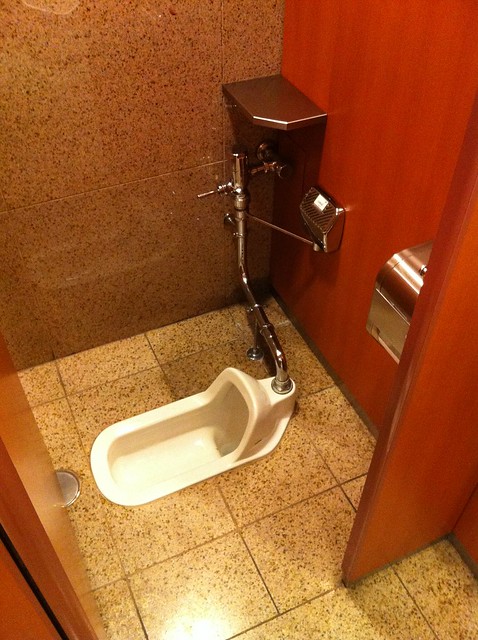

 
Public restroom in Japan


A new model by London designer, Peter Codling

But since most of us are not about to dig up our bathroom floor or buy a $2000.00 "back-to-basics' designer model, what can we do? The answer is simple. And inexpensive!!!
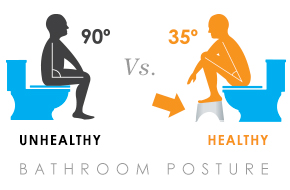

Introducing Squatty Potty!!
  I bought a three pack and put one in each bathroom!! And far from being shy about this new appliance, I love answering curious questions if a visitor works up the courage to ask:))!!

Tuesday, December 30, 2014

New Year, New You---Sugar Free!!

Okay, still working out the kinks in the video-making business, but I decided if I'm ever going to get anything out, I can't wait until it meets all my standards, which would be pretty close to perfection:((

So, with that in mind, I finally just did it---Got out there what I wanted to say!! Heck, I enjoy a ton of You Tube videos, most far from professional. In fact, I like the simple, homemade, imperfect aspect best---They're a major source of inspiration and intrigue for further food and fitness studies! Hope you feel the same:)))


Wednesday, December 17, 2014

Shopping Day

Grocery shopping's not a chore but a treat 

at my favorite co-op grocery!


For twenty years I've been driving an hour away for shopping at a wonderful coop grocery. When my oldest four kids were little doorsteps it wouldn't be unusual for me to be "wearing" my youngest baby, have the three year old in the proper toddler-seat space in the cart, the five year old crammed among the groceries in the main compartment of the cart, and the seven year old "helping" push the cart.

Things have changed a lot now that it's just me and my fifth and youngest doing the shopping. We don't go as often (maybe twice a month) and it's a lot less chaotic (notice, I did not say more fun---sure miss those crazy days!!) We usually go hungry and start out at the wonderful hot bar and deli, linger over coffee (and a special "treat' drink for my daughter) and linger some more as we peruse the aisles reading labels, taking advantage of specials, and generally enjoying ourselves thoroughly!
Hmmm . . .which one? Love both brands but I steer clear of lowfat, so Kalona wins!! Delicious!!
I stock up on things I can't find (at affordable prices, at least) closer to home. And this time, with Christmas only days away, I brought my gift-list along. I love giving friends and family "usable" healthy items for holidays and birthdays, even as wedding or baby shower presents---Always trying to encourage good eating habits and introduce natural health and beauty products, even through gift-giving!


Not giving this delicacy for a gift. No, not even to my pets:))

Another "delicacy" not available closer to home. Thanks for bringing back the original formula GT!!

Hope that you have an awesome grocery nearby that makes your shopping a happy and healthy experience!!! 

Sunday, December 14, 2014

Get Fit While You Sit

Whether you're a 9-5 executive or a busy blogger-mom, 
chances are this has become a tired asana:


In fact hours of sitting at a desk is not only uncomfortable, it's detrimental to health and longevity.  Standard chairs simply don't provide for enough movement. The pelvis is in a "locked-down" position, while the back and upper legs are also held in an unnaturally rigid posture.

A study by the Department of Exercise Science, Arnold School of Public Health, University of South Carolina found that sitting more than six hours a day increases your risk of heart disease alone by up to 64%. Other studies have turned up similar increases for other diseases, such as stroke and cancer high blood pressure, diabetes, and elevated cholesterol. These dire correlations make sense when you consider the way prolonged sitting impacts almost every system in the body. When we are sitting we are not--uh hum--moving, or at least not very much. And movement is essential for optimum functioning of almost all our body's systems.

For example, when we sit brain function slows in response to a less energetic movement of oxygen and fresh blood. Sluggish blood flow can also give fatty acids more time to clog the heart and lead to a host of circulation problems, usually manifesting in the extremities. Of course, it's no surprise that lengthy periods of siting are not healthy for the skeletal system, often resulting in strained neck, tight back and disk damage. If all that weren't enough, excessive sitting also predisposes one to obesity and muscle degeneration.

The obvious option--standing up and moving around a bit--is the best solution and should be employed first and foremost. 10-12 minutes of standing for every hour of sitting is a good rule of thumb. A few companies (mostly in the high-tech world) have taken that recommendation even further:


Standing desks have been spotted at Google, Facebook, Twitter, AOL, and AT&T, to name a few. But sometimes constant standing can be almost as bad (back issues and pooling blood) and it's certainly not always practical or productive.

For those times an exercise (or stability) ball proves a novel and very effective alternative!


Office ball photos from: Home Design Game

When you sit on a movable (unstable) surface your body has to make numerous and constant adjustments. Your spine is forced into alignment. Your core is held firm while the pelvis rotates and twists in minute circles. The soles of your feet roll back and forth and side to side. You can actually push backwards or forwards and roll to reach the phone or pencil. And when someone knocks on the door behind you, the torso turns into a most lovely Ardha Matsyendrasan.


But ball chairs shouldn't be reserved for grown-ups!  The concept works beautifully in the classroom and home school as well! It's becoming increasingly common to see an entire roomful of students peacefully bobbing and swaying on colorful, custom-inflated balls, quietly focused on their work.


In an article published at TheAlternativePress.com, G. Chang details several outstanding advantages of nixing chairs in favor of fitness balls:
Brain research has shown that there is a link between movement and positive academic performance. Sitting on balls makes a student sit up straighter which increases blood flow to the brain and all parts of the body. Combining movement and increasing blood flow should result in the ability to stay on task throughout the day and thus, increase academic learning. According to Roland Katz, an ADHD expert, students with ADHD need to “fidget to focus”. Stability balls allow such movement in a controlled manner without disturbance in the classroom. Proper posture at a young age is important because this is when their bodies are growing the most. When a child has poor posture, they are increasing their chances of developing spinal deformities like scoliosis, kyphosis, and lordosis. Using a stability ball decreases a child's chance of developing these deformities by forcing them to maintain good posture. Students are measured to fit the appropriate size stability ball based on their height and other body dimensions such that the knees are slightly lower than the hips. Furthermore, the use of stability balls should help students become more physically fit because core muscles are engaged and strengthened.
Adult and child alike have much to gain by adopting this legless chair!! Who couldn't use increased circulation, leading to increased brain function and, hence, higher productivity!?!

You will feel more energetic, burn more calories, and tone your muscles as you accomplish a mini-workout all through the day!!!

Here's my own version----makes blogging a breeze:)))


Thursday, December 11, 2014

Light Pollution In The Bedroom


Melatonin is an important hormone produced by our bodies in response to darkness. Lack of sufficient darkness in our sleep environment means lack of sufficient melatonin which can cause a host of problems and even contribute to the formation of life-threatening diseases.

Researchers at Fujian Medical University compared the sleep quality of patients under normal hospital conditions to that of patients who had been provided eye masks and ear plugs. The patients who experienced the quieter, darker environment had more REM time, shorter REM latency, less arousal, and elevated melatonin levels.

But of more concern than the obvious detrimental effects of poor sleep quality, such as fatigue, and inability to concentrate, are the disease processes that appear to be correlated to insufficient melatonin production. Melatonin regulates the reproduction system and low levels of the hormone have been linked to higher incidences of breast and uterine cancers. Elevated rates of male cancers, such as prostate, also appear in subjects with lowered melatonin levels. In addition, low melatonin levels appear to suppress general immune function and hamper proper glucose metabolism, implicating poor production of the hormone in a host of conditions ranging from premature aging to diabetes.

To ensure adequate melatonin production refrain from using computers or watching television a half hour or so before bedtime in order to calm the body's systems and prime it for quality sleep. Make sure your room is quiet and as dark as possible. Use room darkening shades, and power off or cover all the little green and red lights glowing from the monitors, adapters, and chargers planted all over your bedroom. Even your alarm clock could be considered damaging light pollution; turn it face down or cover with a cloth.


If if you must sleep during the day or a completely darkened room is not possible consider using a sleep mask over your eyes. Many varieties are available. Look for brands made with natural/organic fabrics and fillers. Natura Organic carries some cute, organic masks that would make great gifts as well!


These can be stored in the freezer for reducing puffiness! Source: Sew Mama Sew


If you're handy on a sewing machine, here's an easy pattern for making beautiful eye masks filled with organic rice or buckwheat and infused with soothing essential oils

Another cute homemade version. Source: The Good Weekly


Put your mask in a convenient place close by your bed so you're sure to grab it every night and create a great new habit for a healthier you!~!

Source: Trinkets In Bloom